
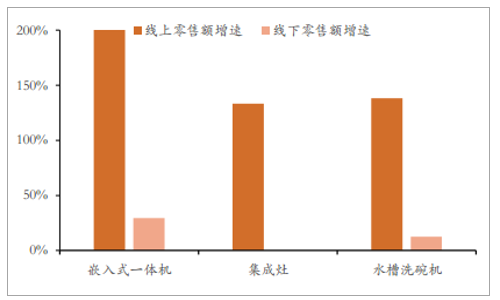
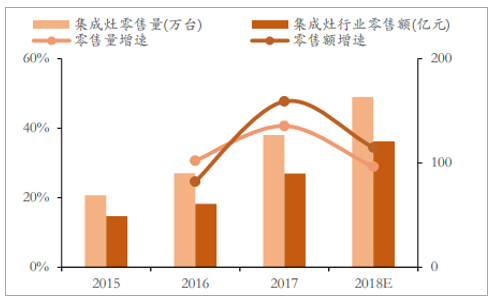
Retail sales of China’s kitchen and bathroom market rose from RMB 108.2 billion in 2012 to RMB 203.5 billion in 2017, representing a compound annual growth rate (CAGR) of 13.5% over the five-year period. In the first three quarters of 2018, the retail value of the kitchen and bathroom market reached RMB 147.3 billion, a year-on-year increase of 0.4%, marking a sharp slowdown in growth. Among categories, disinfection cabinets, electric ovens, range hoods and gas stoves posted substantial year-on-year declines of -16.6%, -8.3%, -7.3% and -5.6% respectively. In contrast, emerging integrated kitchen appliances enjoyed robust growth. Built-in all-in-one machines (combinations of built-in microwave, steam and oven functions) and built-in dishwashers achieved year-on-year retail sales growth of 104.3% and 32.7% respectively, while online retail sales of integrated stoves jumped 133.3% year-on-year. In 2017, integrated stoves recorded retail sales of RMB 8.98 billion, up 47.7% year-on-year.
Retail sales of the kitchen and bathroom market reached RMB 147.3 billion in the first three quarters of 2018, a year-on-year increase of 0.4%.
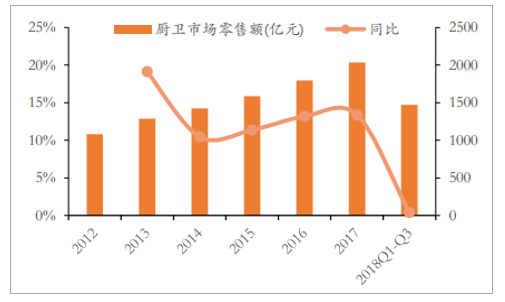
Growth Rate of Retail Sales by Category, China Kitchen and Bathroom Market (Jan–Sep 2018)

High Growth of Integrated Kitchen Appliances, Jan–Sep 2018
Retail sales growth of the integrated stove market is projected to exceed 30% in 2018.
The rapid growth of the integrated stove industry in recent years is largely attributable to its technical advantage in fume extraction rate compared with traditional range hood and stove combinations. Due to China’s traditional cooking habits featuring rich, heavy-oil flavors, especially in central and southwest regions, cooking tends to generate substantial cooking fumes and waste gas pollution that harm residents’ health. Before integrated stoves emerged, most traditional range hoods adopted top-suction European-style hoods or exhaust fans with low fume capture rates, failing to resolve kitchen cooking fume issues. Integrated stoves address the fume problem through innovative technologies and greatly improve consumer experience.
Since its launch, the integrated stove has undergone three rounds of product iteration: the first-generation deep well down-draft type, the second-generation side-suction down-draft type, and the third-generation upgraded side-suction modular technology. Currently, most integrated stoves on the market belong to the third-generation side-suction modular type.
The first integrated stove was developed in 2003. Meida trial-produced the first integrated stove, the deep well down-draft integrated stove. Although it greatly raised the fume capture rate, it had drawbacks including insufficient gas combustion, carbon monoxide generation and consequent potential safety hazards, accumulated grease that was hard to clean, and reduced thermal efficiency caused by being too close to the flame.
The second-generation integrated stove came out in 2005 as the side-suction down-draft model. It successfully solved the safety risks of the first generation. While maintaining a high fume capture rate, it also reduced thermal efficiency loss, bringing major technological innovation to the development of integrated stoves.
The third-generation integrated stove, the side-suction modular model, was launched in 2011. It adopts independent designs for the hood, stove and disinfection cabinet, integrates more functional components and realizes rational space layout, significantly boosting kitchen space utilization.
Since the advent of the third-generation integrated stove, integrated stove technology has basically matured. Side-suction modular integrated stoves remain the mainstream product in the current market. The table below compares the performance advantages of integrated stoves versus traditional hood-and-stove sets:
Performance Comparison: Integrated Stove vs Traditional Range Hood & Stove Set
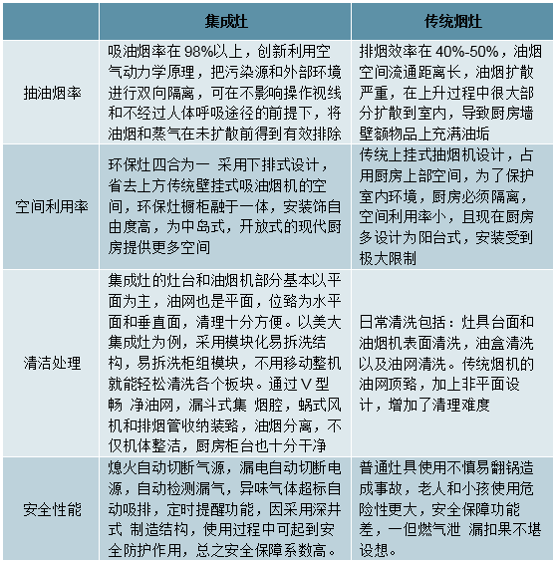
Compared with traditional range hood and stove sets, the core technical advantage of integrated stoves lies in the greatly improved fume capture rate. Adopting side-suction and down-draft technology and applying the principle of micro-aerodynamics, integrated stoves shorten the flue path and draw cooking fumes downward, delivering a substantial improvement in fume extraction efficiency and boasting remarkable advantages over traditional hood-and-stove combinations.
The technical strengths also bring a better user experience. Integrated stoves achieve major improvements over traditional hood-stove sets in daily experience such as noise control, safety and ease of cleaning, as detailed below:
- Noise Control: The down-draft exhaust design of integrated stoves removes the noise source positioned above the user’s head. Combined with ultra-low noise technology and silent air duct design, it operates at low noise levels. Cooking produces no choking fumes and will not cause cooking fume pollution indoors, with notable environmental and health benefits.
- Safety: Integrated stoves are equipped with safety devices including automatic gas cut-off upon flameout, automatic power cut-off in case of electric leakage, automatic gas leakage detection, voltage and current overload detection, and timing reminder functions. They provide protection during operation with a high safety factor.
- Cleanability: Taking Meida integrated stoves as an example, they adopt a modular, easy-to-disassemble-and-clean structure with detachable cabinet modules. Each component can be easily cleaned without moving the whole unit. Featuring a V-shaped high-efficiency oil filter, funnel-shaped fume collection chamber, volute fan and exhaust pipe storage device, they realize oil-fume separation and keep the unit clean.
In addition to the integrated combination of hood, stove and disinfection cabinet available on the market, new integrated solutions have emerged, such as hood+stove plus steam oven / electric oven / steam-roast all-in-one / dishwasher. These diversified combinations greatly enhance product performance to better meet the demands of different consumers.
From the perspective of the product life cycle in the home appliance industry, integrated stoves are currently in the growth stage. This stage is characterized by high market growth rate, rapidly rising market demand, gradually mature technology, distinct industry features, competition landscape and user profiles, as well as a growing variety of product types and competitors. Meanwhile, new tax policies and the trend of consumption upgrading have brought sustained positive factors to the integrated stove industry.
Rising per capita disposable income and personal income tax reform stimulate consumption
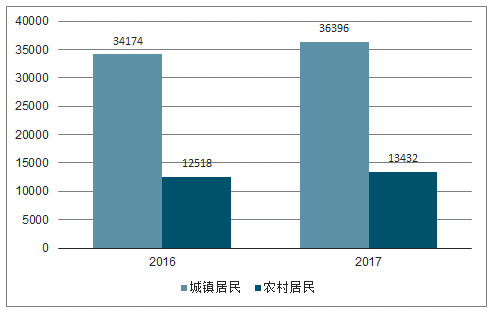
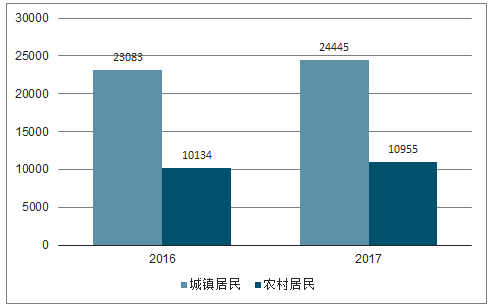
Sales volume of home appliances is closely correlated with residents’ per capita disposable income. In 2017, the per capita disposable income of urban residents reached RMB 36,396, representing a real growth of 6.5% year-on-year; the figure for rural residents was RMB 13,432, with a real growth of 7.3%. The rise in disposable income is expected to directly increase spending on optional home appliances and boost consumers’ willingness to purchase mid-to-high-end kitchen appliances. In 2017, the per capita consumption expenditure of urban residents was RMB 24,445, up by 5.9%; rural residents recorded per capita consumption expenditure of RMB 10,955, an increase of 8.1%.
Changes in Residents' Per Capita Disposable Income, 2016–2017 (CNY)
Changes in Residents' Per Capita Consumption Expenditure, 2016–2017 (CNY)
The tax reform in 2018 mainly benefited middle- and low-income groups and would stimulate greater consumption. Judging from the tax reduction scope of this personal income tax reform, taxpayers with a monthly income below RMB 20,000 enjoyed a 70% tax cut, while those earning RMB 10,000 per month received a 100% tax reduction.
Income & Tax Reduction Comparison: Pre vs Post Tax Reform
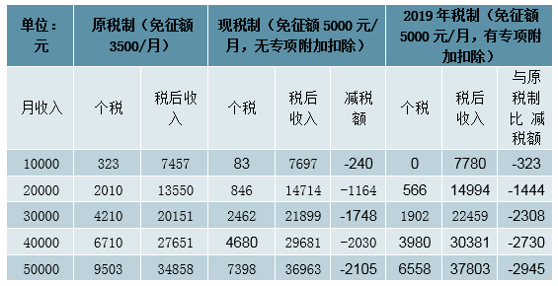
For groups with progressively rising income, the tax reduction rate gradually declines. Especially for households with a monthly per capita income ranging from RMB 10,000 to 30,000, income improvement is remarkable, and their annual household disposable income sees a substantial increase. We believe that tax cuts are favorable for the consumption sector and will stimulate demand for home appliance categories with strong discretionary consumption attributes to a certain extent. Home appliance sales are expected to maintain steady growth after 2019, and we are optimistic about the integrated stove industry, which features strong discretionary consumption characteristics.
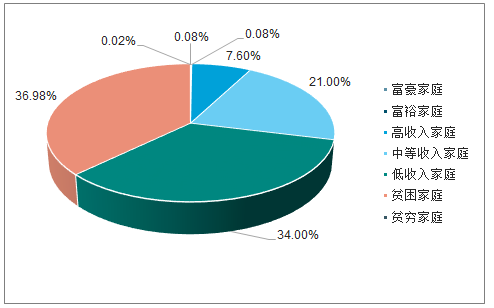
Higher spending among middle-income households after tax reform boosts integrated stove sales: We have conducted a scenario analysis on the annual increase in household consumption expenditure following the tax reform. The research scope mainly covers middle-income households, as well as typical cases of lower-income and higher-income households. In China, middle-income households are defined as those with net assets above RMB 2 million but not exceeding RMB 3 million, and an annual income above RMB 150,000 but not exceeding RMB 800,000, accounting for 21% of the national population. In our scenario analysis assumptions, the pre-tax monthly income of members in middle-income households ranges from RMB 5,000 to 30,000. A combination of two incomes of RMB 5,000 each represents a lower-income household, while two incomes of RMB 50,000 each represent a higher-income household. We assume that households are willing to allocate 20% of the increased disposable income generated by the tax reform to consumption expenditure, which equals the annual incremental consumption amount of the household.
Scenario Analysis: Annual Added Household Consumption Post Tax Reform
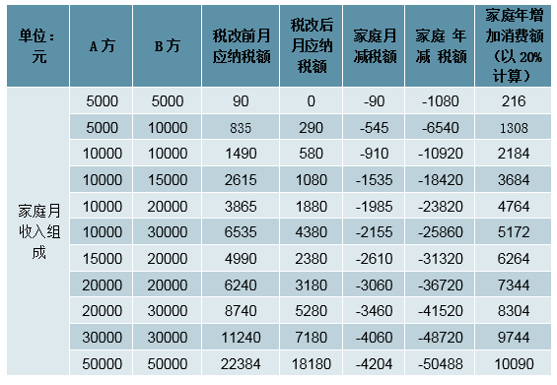
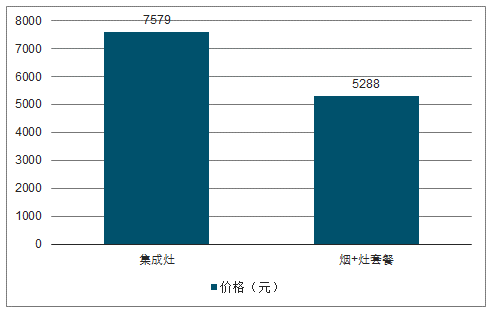
Based on the results of our scenario analysis, the annual incremental consumption of lower-income households after tax reform is less than RMB 1,000 compared with the pre-reform period, while that of higher-income households exceeds RMB 10,000. Market data shows that the average industry price of traditional range hood and stove sets is RMB 5,288, whereas integrated stoves cost RMB 7,579, representing a price premium of more than RMB 2,000. For these two types of households, the extra consumption brought by tax reform cannot affect their purchasing decisions between integrated stoves and traditional hood-stove sets. Higher-income households do not take price as the primary criterion for product selection, and the incremental consumption of lower-income households cannot cover such price difference.
For middle-income households, the annual tax reduction ranges from approximately RMB 6,000 to RMB 50,000, and their annual incremental consumption falls between RMB 1,000 and RMB 10,000. Most households see an annual consumption increase of RMB 2,000–7,000, which exactly matches the premium of integrated stoves over traditional hood-stove combinations. After the tax reform, price elasticity exerts less influence on middle-income households when choosing between integrated stoves and traditional hood-stove sets. Given that integrated stoves have obvious technical advantages over traditional products, integrated stoves become the preferred choice for the vast majority of middle-income households.
Proportion of Households by Income Level in China, 2018
Price Comparison of Integrated Stoves vs. Range Hood & Stove Packages, 2017 (CNY)
Changing Consumption Concepts and Rising Attention to Integrated Stoves
The golden era of consumption upgrading has arrived. Driven by the trend of 'consumerism', people’s willingness to consume has grown stronger, which brings about a shift in consumption philosophy. Specifically, consumers behave more rationally in consumption, attach greater importance to lifestyle taste, and are willing to try new products, replace old goods and make advance purchases.
Distribution of Chinese Netizens' Shopping Consumption Views, 2017
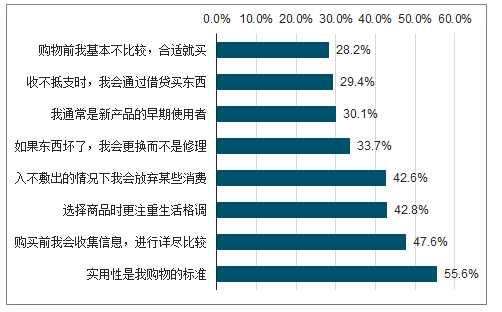
Chinese consumers have adopted more open consumption concepts than before. Over 50% of netizens regard practicality as their shopping criterion, and 47.6% will gather information for thorough comparison before making purchases, indicating an overall trend toward rational consumption among netizens. Compared with five years ago, consumers attach significantly greater importance to lifestyle taste when shopping, with an increase of 24.5%. In addition, more netizens choose to replace rather than repair broken items, become early adopters when new products are launched, and borrow money to make purchases instead of giving up consumption when their expenditure exceeds income.
Overall, people pay more attention to the soft demands for goods. Consumption philosophies have become more open, consumers have clearer requirements for quality, and they are willing to pay premium prices for high-quality products. Meanwhile, they value the sense of identity brought by relevant brands. Such shifts in consumption concepts not only raise consumers’ demand for the quality of integrated stoves but also generate new demand for the renewal of kitchen appliances. Consumers’ willingness to purchase high-quality kitchen products has risen markedly.
Baidu Search Index Trend of Integrated Stoves

Information Index Trend of Integrated Stoves

Baidu Search Index shows that public attention to integrated stoves is rising. In 2017, the average weekly online search volume for integrated stoves stood at approximately 4,000, while that for range hoods was only 1,462, demonstrating that integrated stoves are attracting growing public attention. Since July 2017, the average Information Index related to integrated stoves has reached as high as 15,897. This reflects improved consumer awareness of the product. Consumers no longer focus merely on traditional range hood and stove sets. Driven by consumption upgrading and higher requirements for product quality, more and more consumers pay attention to and choose integrated stoves.
Market Demand Driven by Space Constraints in Small-sized Housing
Compared with the traditional three-piece kitchen appliance set, integrated stoves have the distinct advantage of space saving. Multi-functional integration and space consolidation break space limitations and improve space utilization. In addition, the high fume capture rate of integrated stoves allows kitchens to move away from enclosed layouts and turn into open kitchens. It not only enlarges the visual space of small apartments but also creates a more inviting atmosphere for kitchens.










