
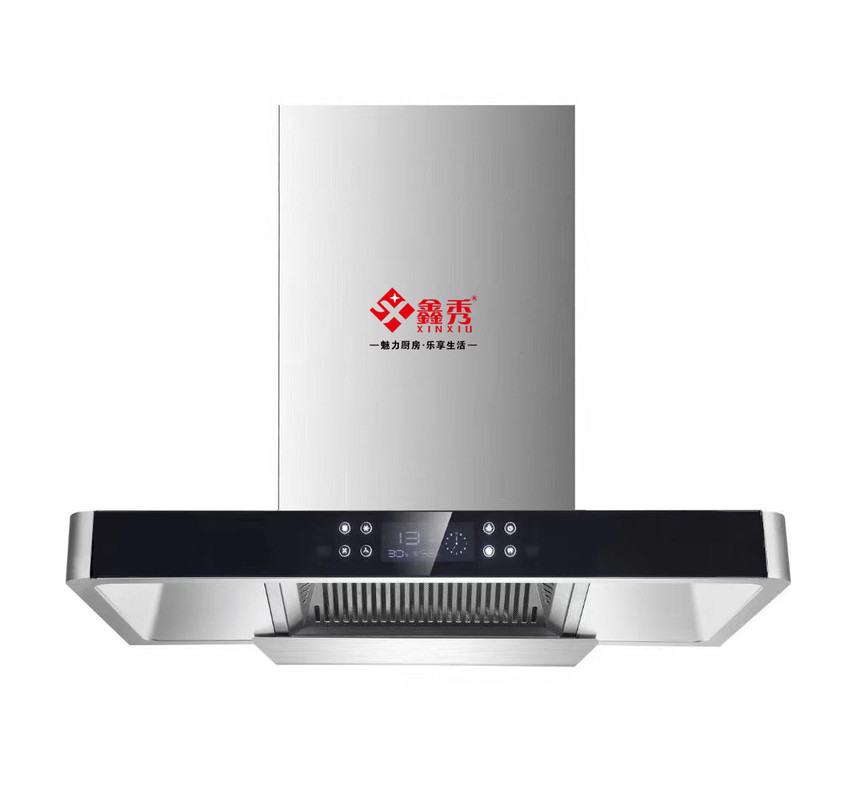
Xinxiu Electric Appliances 6th Generation High Suction King Range Hood
What is high suction power? Why do Chinese kitchens need high suction power range hoods? In 2013, Xinxiu Kitchen & Bath Appliances set the industry standard for high suction power range hoods by using its own products as a benchmark, focusing on three aspects: suction, strong filtration, and fast exhaust.
When range hoods first entered the Chinese market, domestic users found that the original exhaust volume of 8 or 9 m³/min was completely insufficient to combat the high heat and heavy oil of Chinese cooking. Taking stir-frying, a common cooking method in Chinese cuisine, as an example, when ingredients are poured into a wok at high temperatures and with hot oil, a huge amount of smoke will instantly rise. The smoke will quickly spread in all directions. In a confined space, if the range hood's exhaust volume is too small, the smoke will be removed slowly, and the smoke will naturally stay in the kitchen for a longer time.
However, increased airflow also creates a new problem—the escape of cooking fumes. Excessive exhaust volume leads to strong air convection, causing the lateral velocity of fresh air to be much greater than the velocity at which cooking fumes are drawn into the range hood. This disrupts the flow direction of the fumes, causing them to diffuse and escape. Therefore, to achieve a powerful suction effect, it is also necessary to improve the ability to capture and extract cooking fumes.
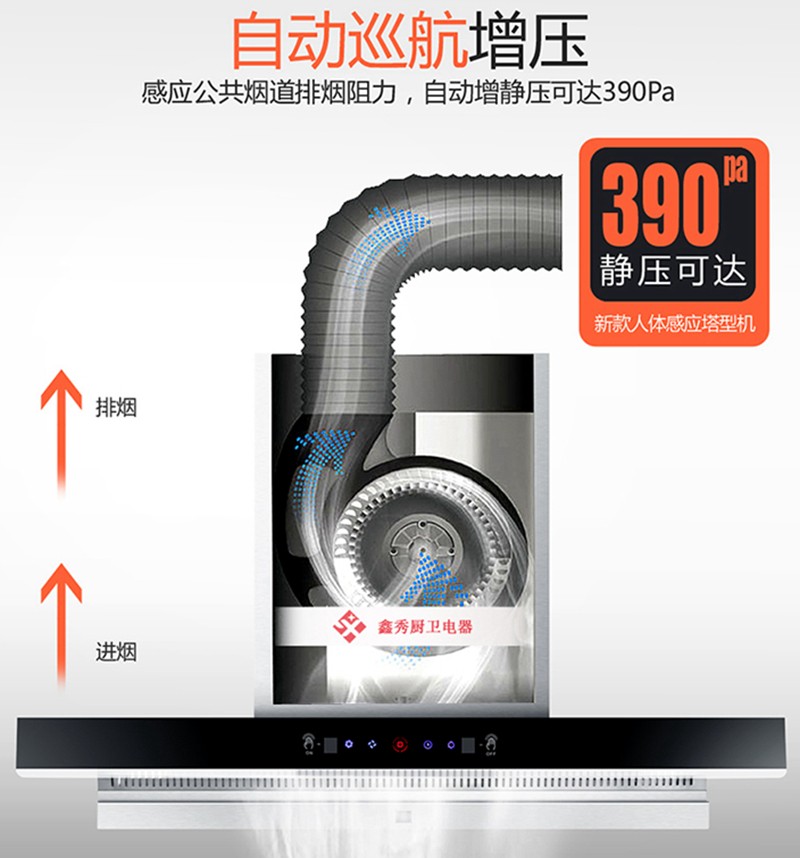
High wind pressure and fast exhaust make cooking stress-free. Wind pressure is also an important indicator of the range hood's strong suction power. The higher the wind pressure value, the stronger the range hood's ability to resist backdraft.
In order to achieve high-altitude emissions, modern apartments in my country generally use shared flues. To ensure smooth airflow, these shared flues must have sufficient cross-sectional area. Taking a 15-21 story high-rise building as an example, national building standards stipulate that the cross-sectional area of the flue is only 12.8 square centimeters, while the cross-sectional area of each household's exhaust pipe is 15 to 18 square centimeters. During peak cooking seasons, multiple households exhaust smoke simultaneously, often making the shared flue insufficient. To address this, technologies such as Venturi transformers, adjustable fire dampers, and backflow prevention caps have been adopted to improve smoke extraction efficiency. However, backflow of cooking fumes is still prone to occur during peak cooking seasons.
Xinxiu Kitchen & Bath Appliances' R&D staff believe that the current design of public flues cannot meet the needs of all users to exhaust smoke at the same time. 'With so many users using range hoods, the public flue naturally has a high 'pressure'. To achieve a good smoke extraction effect, the peak static pressure value after the range hood is turned on must be greater than the external static pressure value to generate an effective pressure difference, thereby increasing the smoke flow rate and improving the smoke extraction effect.'










