Recently, power‑rationing situations have become increasingly severe. Although we have not yet been affected, many of our friends have had their working hours temporarily adjusted due to power cuts. Leaving industrial power consumption aside, domestic power supply in many regions has also been impacted to some extent. Particularly, some areas are still experiencing high‑temperature weather. Taking a shower twice a day, morning and evening, is a necessity. Power rationing brings greater uncertainty to bathing. Against this backdrop, gas water heaters, featuring fast heating speed and lower running costs, have gradually drawn many people’s attention.
Nevertheless, gas water heaters have one drawback: they generate waste gas during combustion, which may adversely affect human health and even cause safety hazards. Therefore, safety performance must be prioritized during product selection. Today we will talk about the classifications of gas water heaters.
- 1.Flue‑vented Type
As the earliest generation of gas water heaters, flue‑vented models are equipped with large exhaust outlets and thick flue pipes, yet they perform poorly against back‑draft wind. Outdoor air may blow backward through the flue pipe into the unit, causing accidental flame‑out or reverse combustion that damages the water heater. Such products shall not be installed on high‑rise floors (only for floors below the 7th floor). Its open‑type combustion chamber delivers low combustion efficiency with Energy‑efficiency Grade 3. This type of gas water heater has been phased out successively and is not recommended for purchase. - 2.Forced‑exhaust Type
Developed from flue‑vented units, this type is fitted with a forced‑exhaust fan. The fan draws outdoor air into the combustion chamber to support combustion, achieving high combustion efficiency with Energy‑efficiency Grade 2. Meanwhile, it forcibly discharges post‑combustion waste gas outdoors. Thanks to high internal air pressure, slim exhaust outlet and special wind‑proof flue pipe at the outdoor end, it is applicable for high‑rise elevator apartments. However, it still has shortcomings: it consumes indoor air. Hence it shall be installed in well‑ventilated locations. - 3.Constant‑temperature Type
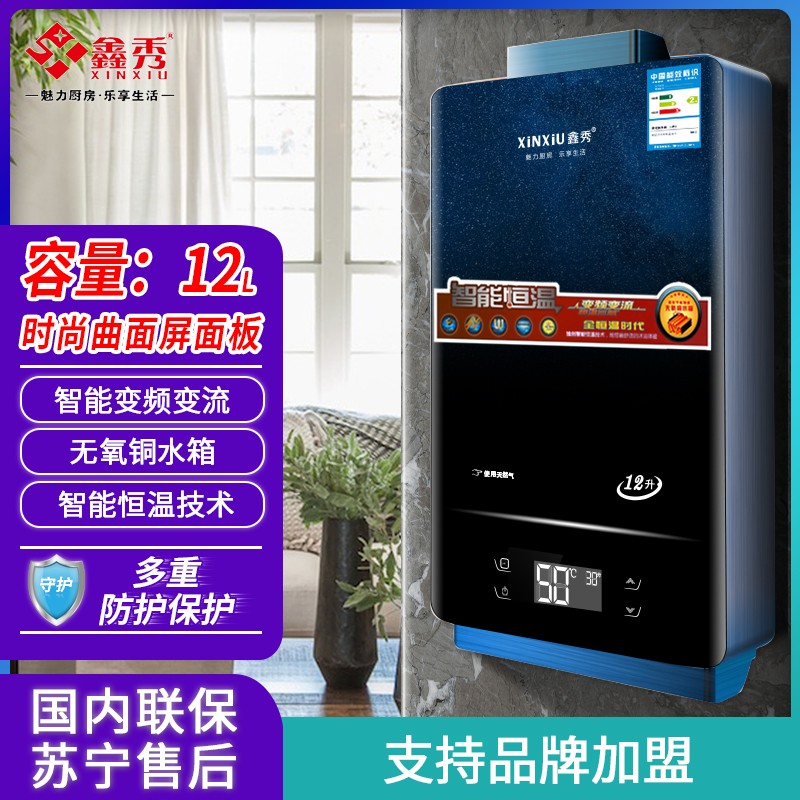
Based on forced‑exhaust structure, two key components are added: a microcomputer display controller and a gas proportional valve. When water pressure, gas pressure or ambient temperature fluctuates, the microcomputer controls the gas proportional valve to automatically adjust gas output for stable water temperature. Constant‑temperature response ranges from 5 to 25 seconds depending on the precision of the gas proportional valve. For a 10‑L constant‑temperature water heater, if water flow is reduced by half, the equivalent capacity drops to around 5 L. Faster temperature stabilization indicates better constant‑temperature performance.
For daily hand‑washing and dish‑washing scenarios that do not require maximum water flow, constant‑temperature units can start and operate normally under low water flow and low water pressure. The outlet‑water temperature remains consistent regardless of flow volume, saving water and gas to a certain extent — a function unavailable for flue‑vented and ordinary forced‑exhaust models. Featuring user‑settable stable temperature and low‑water‑pressure startup, constant‑temperature water heaters are upgraded enhanced versions of forced‑exhaust products and represent the mainstream on the current market.
- 4.Condensing Type
Condensing water heaters deliver high‑efficiency energy‑saving performance and reach national Energy‑efficiency Grade 1. On the basis of constant‑temperature structure, an additional condensing heat exchanger is installed. It recovers heat from high‑temperature waste gas that would otherwise be discharged outside. Meanwhile, it separates condensed water from high‑temperature flue gas to protect the unit against corrosion and extend service life.
Above are the main classifications of gas water heaters. A reminder: no matter which type of gas water heater you install, never place it in an enclosed space. Good ventilation must be guaranteed. Hope this content is helpful to you.