
This year, the market size of China’s domestic dishwasher market is expected to approach the 10‑billion‑yuan level. Wang Lei, Secretary‑General of the China Household Electrical Appliances Association, pointed out at the recently held 2021 China Dishwasher Summit Forum that driven by health‑related demands, localized product designs and energy‑saving requirements, the dishwasher market holds promising prospects.
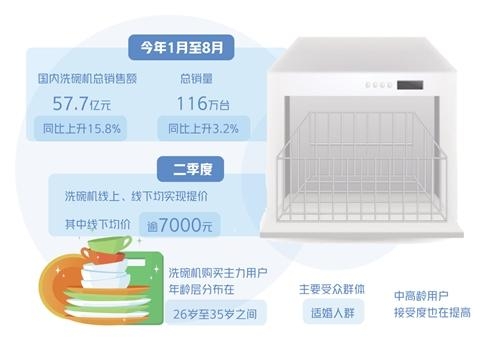
According to A‑v‑O data, the total domestic sales value of dishwashers from January to August this year rose by 15.8 % year‑on‑year to RMB 5.77 billion, while total sales volume increased by 3.2 % year‑on‑year to 1.16 million units.
The dishwasher industry has maintained sound growth momentum since 2015, and several notable shifts have taken place in the market. First, consumer demands have become better‑defined and products show an obvious trend toward high‑end positioning. In the second quarter, both online and offline dishwasher prices moved upward. The offline average selling price exceeded RMB 7,000. This is partly attributable to rising prices of bulk raw materials in the past two years; nevertheless, the key driver behind average‑price changes lies in shifts in the product sales mix. Large‑capacity dishwashers better satisfy consumer needs such as washing pots, handling family‑dinner tableware, disinfection and drying. Consequently, “choose large instead of small” has become a prevailing purchasing principle. Large‑capacity models have become the absolute mainstream offline and are squeezing the market share of small‑capacity products online. Thanks to the higher average price of large‑capacity units, the overall market average selling price has climbed.
Second, dishwashers deliver diversified functions and impose higher technical requirements. For Chinese consumers, dishwashers are expected to do more than merely wash dishes. Features for cleaning baby‑care articles, range‑hood filters and baking tools have become commonplace. Leading brands have further developed dedicated modes such as “fruit‑and‑vegetable wash” and “seafood wash”. Given Chinese users’ habit of leaving cleaned tableware inside dishwashers for long periods, major brands have ramped up R&D on internal‑cavity dry‑air maintenance, enabling tableware to stay dry and clean during long‑term storage. Dishwasher application scenarios have expanded from simple post‑meal cleaning to pre‑meal‑prep washing and long‑term storage.
Furthermore, the proportion of household income spent on home appliances keeps declining, which constitutes the fundamental driver for new‑category home appliances such as dishwashers to gain access to Chinese households. Young consumer demographics including the post‑80s, post‑90s and even post‑00s form the core base of new dishwasher buyers. Currently, the main user group is aged 26‑35, followed by the 36‑45 age bracket. Marriage‑age consumers represent the primary audience, yet acceptance among middle‑aged and elderly users is also rising markedly. As first‑ and second‑tier markets expand and third‑ and fourth‑tier markets are activated, dishwashers are unlocking growth opportunities across broader geographic tiers.
It is reported that although dishwashers relieve households of basic housework burdens, domestic market penetration remains below 3 %. Still, the category has entered a rapid introduction phase and is only one step away from mass popularization. Industry insiders generally believe this transition will take place within the next few years.
Zhang Junjie, Dishwasher Product Director at Robam Appliances, stated that more than 400 new dishwasher brands were registered in 2021. Market prosperity will certainly accelerate popularization, yet technological innovation should always serve as the core driving force for brands to lift market share. Based on research on Chinese kitchen layouts and local cooking characteristics in recent years, Robam Appliances has proposed an overall‑solution concept for Chinese‑style kitchen cooking, centered on high‑suction range hoods and high‑power‑washing dishwashers. Improvements in product technology and performance will be decisive for dishwashers to enter Chinese households.
Lu Yuqi, China Marketing Director of Dishwasher Division at Haier Smart Home, pointed out that backed by its global layout, Haier has spent 25 years absorbing global dishwasher technologies and adapting them for local‑market needs. Internally, dishwashers fall under the Washing Appliance Business Unit together with washing machines, because the two product lines share substantial technical synergies. The enterprise believes dishwashers will eventually become household necessities in China just like washing machines.
“Within five years, annual domestic dishwasher sales have grown from 190 000 units to 1.9 million units, a ten‑fold increase. This achievement comes from joint efforts across the whole industry, including manufacturers, industrial associations and media,” said Lü Shenghua, Editor‑in‑Chief of China Home Appliance Network. According to Lü Shenghua: “After five‑year rapid growth, a sizeable base of early‑adopter dishwasher users has been formed. We shall also pay attention to real‑world user experience and popularize consumer knowledge for existing users.” Against this backdrop, China Home Appliance Network partnered with finish, a professional dishwasher‑detergent brand, to compile the White Paper on Development Status and Consumer Research of China’s Dishwashers and Special‑Purpose Detergents, focusing on proper detergent usage and correct dishwasher operation.










