
I. Overview of the Range Hood Industrial Chain
A range hood is a household kitchen appliance designed to extract cooking fumes generated during food preparation. At present, two main types of range hoods are widely used in residential kitchens in China: Chinese‑style and European‑style models. In terms of the industrial chain, the upstream sector mainly consists of cold‑rolled sheets, lighting devices, stainless steel, motors and other components. Downstream sales are realized through supermarkets, home‑appliance specialty stores, brand direct‑sale stores and e‑commerce platforms.
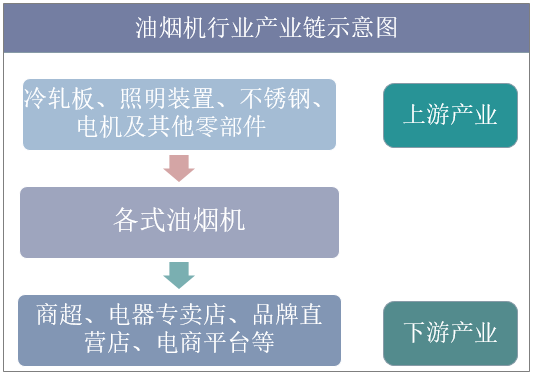
Schematic Diagram of the Range Hood Industry Chain
Cooking fumes contain a large number of harmful substances. The main function of range hoods is to purify cooking fumes, reduce oil and dust content in fumes, and lower fume‑related pollution. Therefore, range hoods occupy an important position in the household kitchen‑appliance market.In 2018, among major categories of large‑size household kitchen appliances, the hood‑stove‑disinfection cabinet segment, dishwashers and built‑in products accounted for 82%, 8% and 10% respectively. Range hoods took the largest share at 49%.
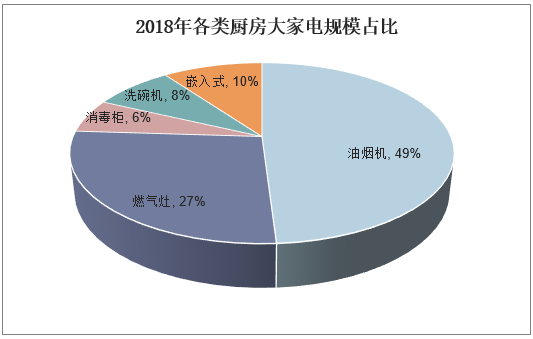
Market Share of Large‑sized Kitchen Home Appliances by Category, 2018
II. Current Development Status of the Range Hood Market
In the 1980s, the first externally‑vented range hood was put into production by Shanghai Zhideng Factory, marking the start of China’s range‑hood industry. In recent years, driven by urbanization, the household ownership of range hoods in China has kept rising. According to statistics, China’s output of range hoods reached 29.49 million units in 2018, a year‑on‑year decrease of 0.2 % compared with 2017.
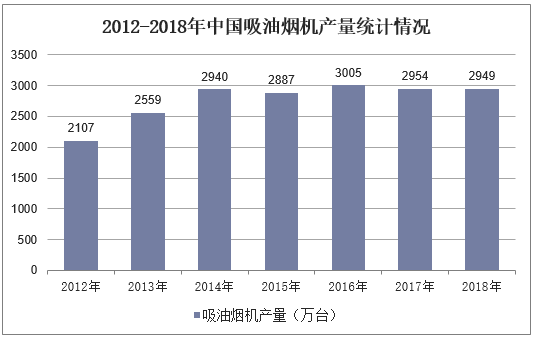
Statistics on China’s Range‑Hood Output, 2012‑2018
Affected by domestic real‑estate adjustment and the substitution effect of emerging kitchen‑appliance products, China’s domestic sales volume of range hoods reached 17.93 million units in 2018, representing a year‑on‑year decline of 5.0 % compared with 2017.
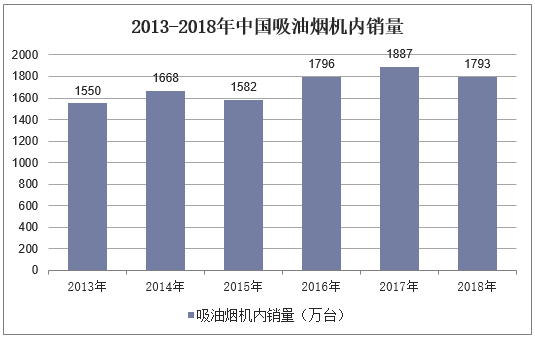
China’s Domestic Sales Volume of Range Hoods, 2013‑2018
Benefiting from the renovation‑oriented attribute of kitchen appliances, consumers show low price sensitivity. Hood‑stove‑disinfection cabinet packages are moving away from low‑price competition. The sales proportion of mid‑end products priced at 2,000‑3,000 RMB is rising steadily. In recent years, the average market price of range hoods in China has increased year by year. The average offline retail price of domestic range hoods rose from RMB 2,109 in 2012 to RMB 3,309 in 2018.
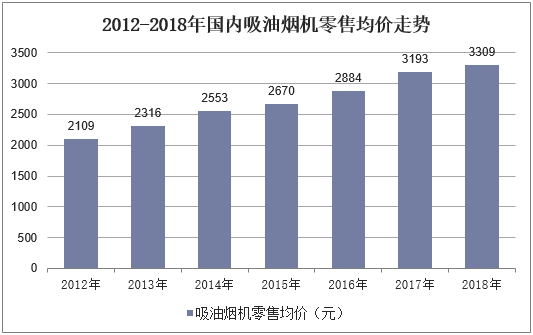
Trend of Domestic Average Retail Price of Range Hoods, 2012‑2018
III. Market Pattern of the Range Hood Industry
In recent years, the kitchen appliance industry has witnessed intensified market reshuffling. Leading enterprises have further captured market share by virtue of strong capital and R&D capabilities, and the market concentration of China’s range hood industry has increased year by year.
At present, the industry is mainly divided into three tiers. The first tier is represented by Robam and Fotile, which accounted for 18.5% and 16.8% respectively of offline retail sales from January to July 2019. The second tier consists of Midea, Vatti and Haier, representing 9.8%, 8.7% and 6.1% of offline retail sales respectively over Jan-Jul 2019.
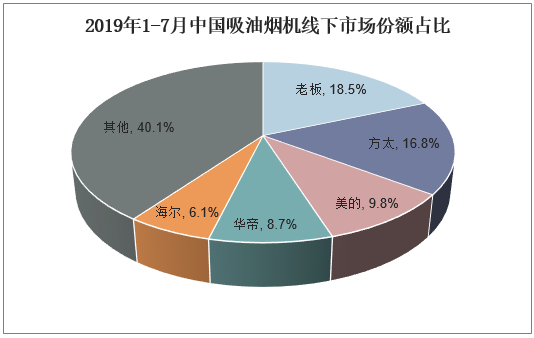
China Offline Market Share of Range Hoods, January–July 2019
From the online perspective, thanks to the large number of range hood brands online, competition is relatively fierce and market concentration is lower compared with the offline market. The top five brands hold a combined market share of 41.3%, among which Midea ranks first with a 15% market share.
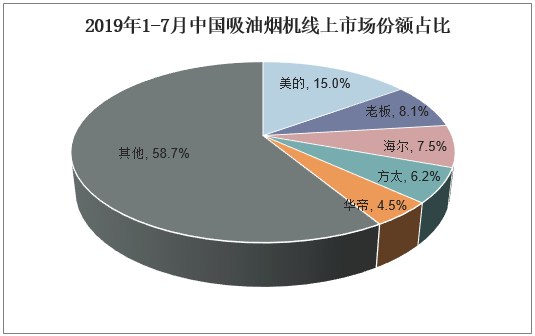
China Online Market Share of Range Hoods, January–July 2019
IV. Development Trends of Range Hoods
- 1.Attractive Appearance Design
Judging from the history of product iteration, there is limited differentiation in core components at the manufacturing end. Therefore, R&D of range hoods focuses more on appearance styling and quality & process control. Starting from the early Chinese deep-cavity type, Q-type rear cooker hoods, European T-type hoods and near-suction hoods, up to today’s integrated range hoods, aesthetic and high-grade appearance design has become a persistent differentiation target for manufacturers. - 2.Energy Conservation and Environmental Protection
With the improvement of people’s living standards and rising environmental awareness, the hazards of cooking fume emission have been widely recognized. Issues such as single function, poor safety performance, and lack of energy-saving and eco-friendly features have constrained the standardized production and development of range hoods. After long-term development, modern range hoods feature mature appearance designs and more diversified and sophisticated functions. Hence, developing energy-saving and environmentally friendly range hoods through technological upgrades has become a major development direction for China’s range hood industry. - 3.Intelligence
Born alongside China’s rapid economic growth and the internet, the post-80s and post-90s generations form a large age group (19–39 years old) in China’s population structure. Undoubtedly, these two generations will be a key driving force of the consumer market in the future. Their consumption characteristics act as a weathervane for market shifts: they value quality of life and pursue products with high performance, superior quality and intelligent features.










