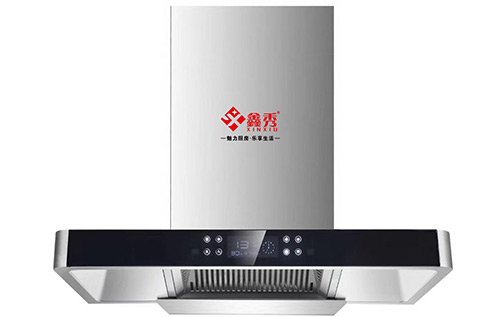
Range hoods are frequently‑used home appliances in daily‑life household kitchens. With continuous technological advances, various types of range hoods have emerged, including under‑cabinet suction hoods, European‑style hoods, side‑suction hoods, Chinese‑style hoods and others. Regardless of appearance variations, extraction performance should be your core consideration during selection. How do we evaluate range‑hood performance? Two key indicators shall be referenced: wind pressure and air extraction volume. Let us take a closer look at these two parameters.
- 1.Wind Pressure
Wind pressure of a range hood refers to its static‑pressure value when the air‑extraction volume reaches 7 m³/min (pressure exerted on an object at rest or in uniform motion), measured in Pa. A higher static‑pressure value delivers stronger anti‑back‑draft capacity for the range hood and effectively prevents cooking‑fume backflow for superior exhaust performance. The maximum static‑pressure value determines the maximum allowable length of the exhaust duct connected to the hood. Greater wind pressure is required to avoid fume backflow when the hood is far from the exhaust pipe or public flue, or for households on high floors. Most products available on the market deliver wind pressure of 300 Pa or above, which represents the optimal range. - 2.Air Extraction Volume
Air extraction volume means the exhaust air volume per unit time during hood operation, with the unit m³/min. Larger air‑extraction volume enables faster removal of heavy cooking fumes from the kitchen. Nevertheless, higher air‑extraction volume does not always mean better performance. Excessively large air‑extraction volume will draw away excessive heat and interfere with the normal heat output of the gas stove.
Products on the market are categorized into five groups by air‑extraction volume: ≤10 m³/min, 11‑14 m³/min, 15‑17 m³/min, 18‑20 m³/min, and ≥21 m³/min. Below are practical suggestions for picking a suitable range hood under different scenarios.
- 1.Cooking Habits
As the old saying goes, food is the paramount necessity of the people. No matter how well‑equipped the kitchen is, cooking your favorite food remains the priority. Select your range hood according to your family’s cooking style. For light‑flavor cooking, a 14‑15 m³/min range hood will suffice. For heavy‑flavor stir‑frying, a model with air‑extraction volume above 17 m³/min is recommended. - 2.Kitchen Conditions
Kitchens are classified by area: 2‑3 m² for compact kitchens; 3‑4 m² for one‑bedroom‑one‑living‑room apartments; 4‑5 m² for two‑bedroom‑two‑living‑room and three‑bedroom‑two‑living‑room apartments; 5‑8 m² for four‑bedroom‑two‑living‑room or larger apartments; and individual kitchens over 10 m². Kitchens can also be divided into enclosed kitchens and open‑plan kitchens. - 3.Building Floors & Flue Layout
For self‑built houses, a 15 m³/min range hood is adequate. Most households nowadays live in multi‑story apartment buildings. Floor height and flue‑duct length are major factors contributing to fume backflow and odor cross‑contamination. Longer exhaust ducts bring greater exhaust resistance. Under such circumstances, select a range hood with air‑extraction volume above 17 m³/min, or one equipped with an automatic pressure‑boosting function.
Above is our guidance on range‑hood selection based on wind pressure and air‑extraction volume. Hope you can find the right range hood for your household.