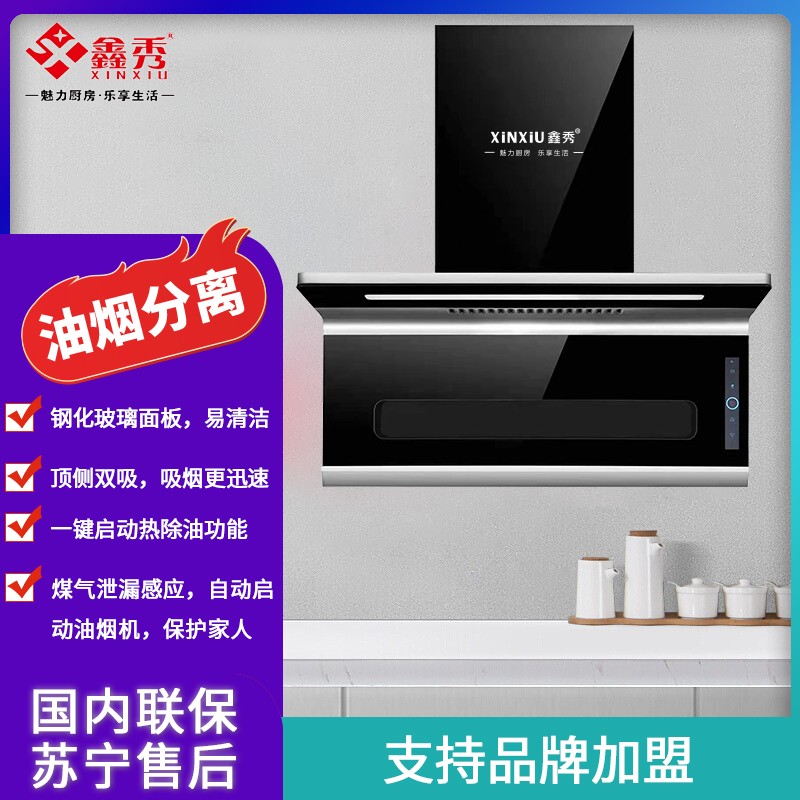
With social development, more and more people prefer to convert their home kitchens into open‑plan kitchens. Such design guarantees sufficient kitchen lighting, prevents the beautifully‑renovated kitchen from feeling isolated, and facilitates communication among family members. Nevertheless, cooking fumes remain a troublesome issue. Today we will discuss what kind of range hood is suitable for open‑plan kitchens.
- 1.Chinese‑style Range Hoods
Compact, lightweight and cost‑effective. They work well for small‑sized enclosed kitchens, yet are less ideal for open‑plan kitchens. - 2.European‑style Range Hoods
European‑style range hoods are mounted above the cooktop.
Most conventional range hoods available on the market are top‑suction models, which are installed above the cooktop and extract cooking fumes via the upper exhaust fan. Top‑suction range hoods include Chinese‑style, European‑style and semi‑deep types that sit between the two categories.
For top‑suction range hoods, the fan system is placed at the top of the smoke‑collecting cavity. The air‑inlet directly faces rising cooking fumes. By shortening vortex residence time of fumes inside the cavity, fast fume evacuation is achieved. It adopts a fully sealed exhaust chamber completely isolated from the main body. Grease‑filter screens separate oil from fumes to reduce corrosion on motors and fan blades, while air flow rate is greatly improved, delivering outstanding fume‑extraction performance.
- 1.Combined with stainless‑steel and tempered‑glass materials, Xinxiu European‑style top‑suction range hood features an elegant and agile look, ideal for freedom‑oriented individual‑style users.
- 2.European‑style range hoods generally come in three shapes: tower‑type, T‑type and arc‑type. With decent and sleek appearances, they are perfect choices for minimalist and fashionable‑style kitchens.
- 3.Top‑suction Chinese‑style range hoods are also known as deep‑cavity range hoods. Their extra‑large and deep smoke‑collecting cavity effectively traps cooking fumes and prevents fume escape and diffusion, making them powerful performers for fume extraction in kitchens.
Advantages: Diverse appearances, easy‑to‑clean.
Disadvantages: Risk of excessive fume suction pressure, oil dripping and other inconveniences.
- Side‑suction Range Hoods
Developed in recent years, side‑suction range hoods break traditional design and fume‑extraction patterns. They draw cooking fumes from the side during cooking and achieve satisfactory fume removal. The fume‑separation panel built inside side‑suction units solves the tough problem of heavy fumes generated by high‑heat Chinese‑style stir‑frying. Adopting side air intake and fume‑separation technology, these hoods realize high fume capture rate and high purification efficiency, making them range hoods truly tailored to Chinese household cooking habits.
For side‑suction European‑style range hoods, the air‑inlet sits much closer to fume sources. It captures fumes at the very first moment and shortens the rising distance of fumes for better exhaust performance. Thanks to the open‑style smoke‑collecting cavity design, cooking space is enlarged. Users will not feel cramped while cooking, and head‑knocking accidents are effectively avoided.
Advantages: Excellent exhaust performance, no cramped feeling, no risk of head‑knocking or oil dripping, thorough fume extraction, eco‑friendly and energy‑saving.