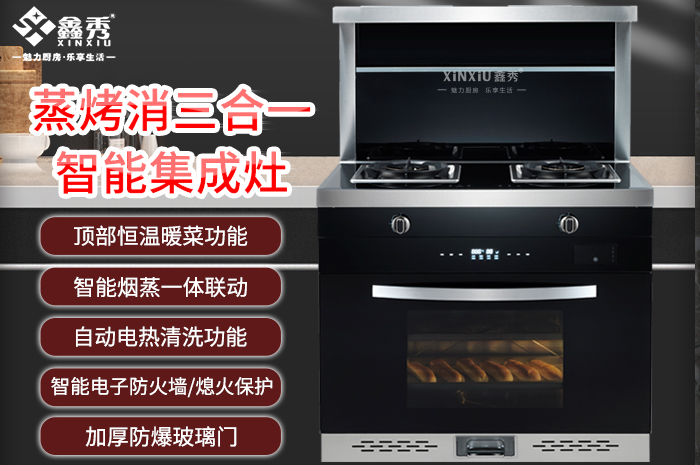
With social progress, people’s living standards have improved greatly. Chinese people whole‑heartedly embrace the saying “Food is the paramount necessity of people”, and none of this would be possible without the kitchen. As we all know, the kitchen normally contains the largest number of home appliances in a household: range hood, refrigerator, rice cooker, oven, microwave oven and many more. No need to list them one by one. Regardless of kitchen size, numerous appliances tend to create a cluttered look. With this in mind, Xiao Xin would like to introduce today’s main subject: the integrated stove.
Since the launch of China’s first domestic integrated stove in 2003, 18 years have passed. Compared with other kitchen appliances, it is still a relatively new product, and simply combining multiple functions together does not always bring good results. In recent years, growing public recognition has driven rapid development across the whole industry. Today Xiao Xin will walk you through integrated stoves, hoping to offer practical reference for your purchasing decisions.
Popular Science on Integrated Stoves
To start with, an integrated stove is a multi‑functional kitchen appliance that combines a range hood, gas burner, steamer, oven, disinfection cabinet and other modules. Installing one integrated stove can save the space occupied by four separate kitchen appliances. Therefore, it works especially well for kitchens with limited area and maximizes space utilization.
Advantages of Integrated Stoves
1. Versatile functions & space‑saving
All integrated stoves are equipped with a built‑in range hood, while users have multiple options for burner units: induction cooker, ceramic hob or gas burner. You may select two identical or different burner types according to personal habits. The lower cabinet can be configured as oven, steamer, disinfection cabinet and so forth. Such flexible configuration enables one single appliance to satisfy diverse cooking demands.
2. Excellent fume‑extraction performance
Fume control is critical for small‑size, poorly‑ventilated kitchens, and integrated stoves address this pain point effectively. Existing integrated stoves achieve a fume‑removal rate of 95%, and some premium models reach an extreme rate as high as 99.95%. In comparison, conventional top‑mounted and side‑mounted standalone range hoods generally deliver around 80%‑90% fume‑removal efficiency. Integrated stoves greatly reduce fume escape, though there remains much room for further improvement for this relatively new product category.
3. Stylish appearance for better interior matching
Modern‑day home decoration pursues both practicality and visual appeal. Nice‑looking surroundings bring better mood. Integrated stoves deliver both practical performance and attractive aesthetics. They can be seamlessly matched with custom kitchen cabinets and fit modern‑style home decoration preferences.
How to Choose an Integrated Stove
1. Confirm your functional requirements
Besides the range hood, other modules are configurable. This does not mean you can freely assemble parts, but rather pick a finished model matching your actual needs. For the burner section, decide whether you want dual‑gas burners, one gas plus one electric burner, or dual‑electric burners. For the lower compartment, choose between steam‑oven combination, disinfection cabinet or storage cabinet. Make your selection based on daily cooking habits to avoid buying functions that end up unused.
2. Easy‑to‑clean structure
Cleaning concerns cover not only outer surfaces but also internal components such as grease filters and fan wheels. For example, Teflon‑coated surfaces repel grease and can be wiped clean effortlessly after cooking. Internal parts adopting similar treatment bring better user experience and longer service life. For the steamer liner, check whether it features seamless one‑piece molding. Beyond visual beauty, seamless construction prevents dirt and grease from accumulating inside. When selecting the gas burner unit, verify whether the burner head can be disassembled for cleaning.
3. Material selection
Stainless steel and tempered glass are the two mainstream materials for integrated stoves. Stainless steel is recommended for the back‑plate of the head section: it is heat‑resistant, easy to clean and highly safe. The cooking surface easily collects grease. Stainless‑steel cooktops feature high strength, convenient cleaning and reliable safety. Note: do not use hard tools such as steel wool, as they will leave scratches. Tempered‑glass cooktops deliver a more premium visual effect and are also easy to wipe. Choose according to personal preference.
4. After‑sales service
An integrated stove integrates range hood, gas burner, steam‑oven unit, disinfection cabinet and more. Its complex structure means ordinary users cannot handle most malfunctions by themselves. Reliable after‑sales support removes worries for end‑users. Select brands with trusted reputation and complete after‑sales services for reassuring and comfortable usage.
Above is the introduction to integrated‑stove basics and purchasing tips. Hope this content is helpful to you.